52100
Staff accuracy rates across requesters at one firm




Forty-four pages on the parts of records retrieval that don't get discussed: what performance data reveals about a firm, what federal courts already decided about HITECH, where client records are actually handled, and what automation cannot be trusted to do.
THE THROUGH-LINE
What performance data reveals about a firm, and who looks away.
HITECH after Ciox, ABA 08-451, and where records are actually handled.
The cost of automating judgment out of records work.
FEATURED STORIES
Three firms each received detailed performance reports tracking every request, every error, and the dollar cost of each problem. Each terminated the vendor shortly after receiving it.
See How It WorksA firm fired its retrieval vendor, not for late records, but because the vendor refused to send a letter. The legal assumption underneath is one federal courts dismantled six years ago.
See How It WorksABA Formal Opinion 08-451 is unambiguous: when a firm outsources work to an outside party with access to confidential client information, the client must be told. Before, not after.
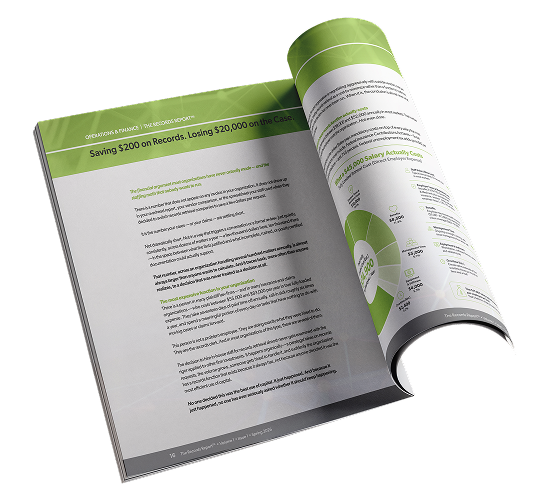
See How It WorksThe financial argument most organizations have never actually made: what an in-house records function really costs once the math is finished.
See How It WorksWhat $6.50 buys in 2026
A Grande latte at Starbucks costs between $5.95 and $6.75 in 2026. That is roughly what $6.50 buys. One coffee drink.
It is also what a patient pays for their own chart under the HITECH patient rate. The same 1,486 pages, requested through a law firm, came back billed at $1,112.06. Same hospital, same file, same work.
THE HITECH PATIENT RATE
$6.50THE HOSPITAL'S INVOICE FOR 1,486 PAGES
$1,112.06171x the rate the law sets for a patient requesting the same file.
THE BIG QUESTIONS
Not stored. Not delivered. Handled, in the moment between when the request goes out and when the records come back. Most organizations have never asked. Four questions settle it.
Confident, documented answers mean the organization is in a reasonable position. Silence means the work starts now. The exposure is not waiting.
52100
Staff accuracy rates across requesters at one firm
5583
Fully loaded annual cost of one in-house records clerk
831
AI hallucination rates documented in medical contexts, 2024-2025
3.3x
Illustrative in-house cost versus vendor cost across 400 cases
TECHNOLOGY & OPERATIONS
Automation increases speed. Human involvement creates accuracy. The best systems combine both. AI can be an enabler almost anywhere, but in the Human-First Zone it is not a decision-maker, and medical records retrieval, review and interpretation all sit in that zone.
LOW ERROR COST
Automate freely; errors are inexpensive or easily corrected. Document classification, standard summaries.
MIXED ERROR COST
Use AI to assist, but require human review and final decision. Contract review, compliance checks, medical coding.
HIGH ERROR COST
Only humans should decide. The stakes are too high and the judgment is irreplaceable. Medical record review, physician interpretation, claim decisions.
THE FULL ISSUE
Get the complete issue, including the data, analysis and insights behind these stories.
Where the industry is putting its technology money, plus Dr. Magdalena Lange at CLM 2026.
What an Accuracy & Performance Report reveals about the true cost of a records process.
Travel hacking as an art, by Kevin Silva, MBA, Chief Strategy Officer.